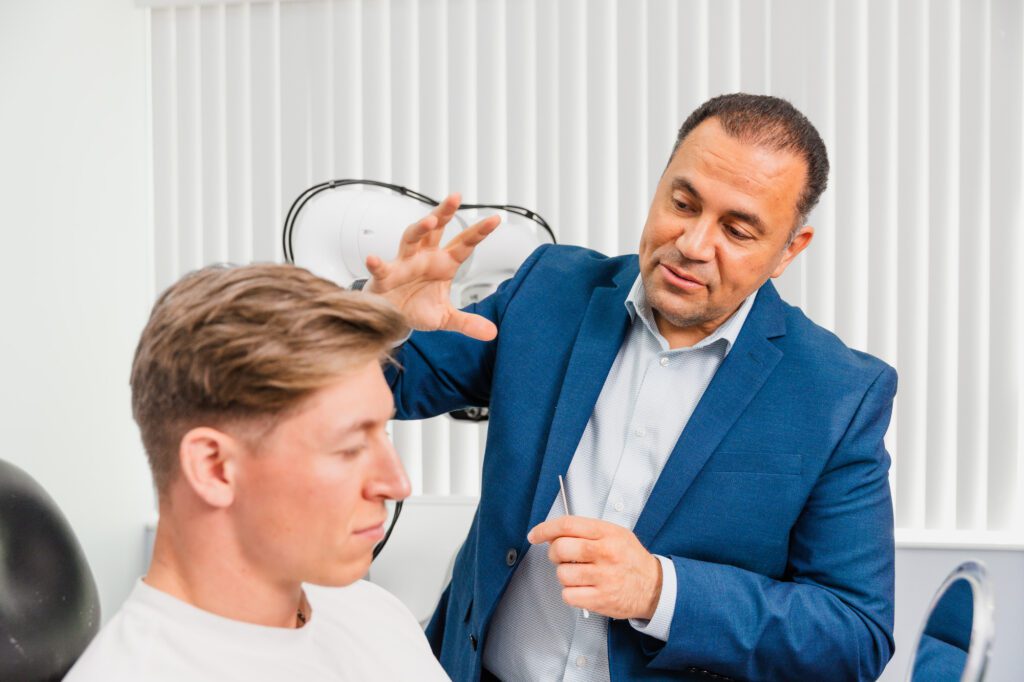
Hair loss rarely happens overnight. You may first notice your hairline beginning to recede, thinning around the temples, less coverage at the crown, or simply that your hair doesn’t look as full as it once did. Because hair loss is often gradual, knowing when to take action, and which treatment is right for you, isn’t always straightforward.
If you’re researching hair transplants in Santa Monica, you’ve probably encountered terms like FUE, FUT, grafts, donor hair, robotic transplantation, PRP, shedding, and regrowth. Understanding what those terms actually mean can help you make a more informed decision about your hair restoration journey.
At Younique Hair Restoration, Dr. Mark Youssef takes a comprehensive, personalized approach to hair loss. Depending on your stage of hair loss and individual needs, your treatment plan may include Robotic ARTAS® Hair Transplants, Platelet-Rich Plasma (PRP), LED Light Therapy, Exosome Serum, targeted nutritional support, or a combination of approaches designed to slow hair loss, stimulate growth, and restore fuller, healthier-looking hair.
The goal isn’t simply to replace lost hair. It’s to understand where you are in the hair-loss process and determine what can realistically be done to preserve and restore your hair.
Here’s what to know before, during, and after a hair transplant.
Understanding Hair Loss: Why Timing Matters
One of the most important things to understand about hair restoration is that not all hair loss requires the same treatment.
Hair loss can occur for a variety of reasons, including age, hormonal changes, and genetics. The American Society of Plastic Surgeons notes that family history, aging, and hormonal changes are among the primary contributors to hair loss.
But the stage of hair loss matters, too.
Dr. Youssef emphasizes the importance of taking action while follicles are still active. For patients experiencing earlier stages of thinning, nonsurgical hair restoration may play a role in supporting existing follicles. Once an area has progressed to more established hair loss, transplantation may become a more appropriate option.
That’s why the first question doesn’t necessarily need to be: Do I need a hair transplant?
A better question is: What stage of hair loss am I experiencing, and which hair restoration approach makes sense for me?
Hair Transplant or Nonsurgical Hair Restoration?
Hair transplantation isn’t the only option we offer at Younique.
For patients experiencing earlier thinning, a personalized treatment plan may include nonsurgical therapies designed to support existing follicles and overall hair health.
Younique’s current hair restoration options include PRP, Exosome Serum, LED Light Therapy, and customized nutritional support in addition to hair transplantation.
These treatments serve a different purpose from transplantation. A hair transplant physically relocates follicles from a donor area to an area where greater coverage is desired. Nonsurgical treatments are generally aimed at supporting follicles that are already present.
For some patients, one approach may be appropriate. For others, Dr. Youssef may recommend a more comprehensive plan.
That distinction is important because successful hair restoration isn’t necessarily about choosing the most aggressive treatment. It’s about choosing the right treatment for the stage and pattern of hair loss you’re experiencing.
Are You a Good Candidate for a Hair Transplant?

Wanting fuller hair doesn’t automatically mean transplantation is the right next step.
One of the most important factors is the availability of healthy donor hair. Hair transplant procedures rely on existing follicles, typically from areas along the back or sides of the scalp, to provide hair for transplantation.
The American Society of Plastic Surgeons similarly notes that healthy growth in the donor areas is an important consideration when determining candidacy. Hair characteristics such as texture can also influence the cosmetic result.
Your consultation should consider more than how your hair looks today.
Dr. Youssef will need to evaluate your pattern of loss, donor supply, scalp health, previous hair restoration treatments, medical history, goals, and realistic expectations for the future.
This is especially important because a transplant does not necessarily prevent your existing, non-transplanted hair from continuing to thin. Continued hair loss can affect the appearance of the result over time, which makes long-term planning an important part of the process.
FUE vs. FUT: What’s the Difference?
If you’ve spent any time researching hair transplantation, you’ve probably encountered two acronyms: FUE and FUT.
FUE, or Follicular Unit Extraction, involves individually harvesting hair follicles from a donor area and transplanting them into areas where additional coverage is needed.
FUT, or Follicular Unit Transplantation, takes a different approach. A strip of hair-bearing skin is removed from the donor area, and individual follicles are then prepared for transplantation.
One of the primary differences is how the donor follicles are harvested.
At Younique, Dr. Youssef primarily uses FUE techniques, including the ARTAS® robotic system.
What Makes ARTAS® Robotic Hair Transplantation Different?
ARTAS® brings robotic technology into the FUE process.
Younique uses the advanced ARTAS® system as part of its approach to harvesting individual follicles without the linear scar associated with strip-based transplantation. The practice highlights natural-looking results, minimal downtime, and faster recovery among the benefits of its ARTAS® approach.
But technology alone doesn’t create a natural-looking hair transplant.
Hairline design matters. Follicle placement matters. Direction matters. Density matters. And managing the available donor hair matters.
The goal shouldn’t simply be to transplant as many follicles as possible. It should be to create a result that works with your facial proportions, existing hair, available donor supply, and potential future hair loss.
Want to see how the technology fits into the hair transplant process? Watch Younique’s video below for a closer look at ARTAS® robotic hair restoration.
What Happens Before Your Hair Transplant?
Your procedure begins long before the first follicle is harvested.
During your consultation, Dr. Youssef can evaluate your scalp, pattern of hair loss, available donor area, and goals. This is also the time to discuss previous hair-loss treatments, medications, medical conditions, and what you realistically hope to achieve.
Once you decide to proceed, you’ll receive instructions specific to your procedure.
Those instructions matter. Certain medications or supplements may need to be adjusted under medical guidance, and smoking can interfere with healing. Your surgical team will tell you exactly what you should and shouldn’t do before treatment.
What Happens During an ARTAS® Hair Transplant?
Every treatment is customized, but the process generally involves several key stages.
1. Preparing the Donor Area
The donor area is prepared so individual follicles can be identified and harvested. For FUE, these follicles are typically obtained from areas with stronger hair growth, often along the back of the scalp.
2. Harvesting Individual Follicles
Rather than removing a strip of scalp, FUE harvests follicles individually.
With ARTAS®, robotic technology assists with the harvesting process. The number of grafts needed varies depending on your degree of hair loss, donor supply, treatment area, and desired result.
3. Planning the Recipient Area
This is where the aesthetic side of hair restoration becomes especially important.
The new hair needs to complement your existing growth pattern and facial proportions. A natural hairline shouldn’t look perfectly straight, uniformly dense, or artificially placed.
4. Placing the Grafts
The harvested follicles are placed into the recipient areas according to the treatment plan.
Placement, angle, direction, and distribution all influence how naturally the transplanted hair blends with the hair around it.
5. Completing the Procedure
An ARTAS® procedure typically takes approximately four to eight hours, depending on the number of grafts. Some procedures may take longer, depending on graft count and the treatment plan. Patients remain awake and comfortable throughout treatment.
Ready to Find Out Whether You’re a Candidate?
The first step isn’t trying to calculate your own graft count or choosing a treatment based on something you saw online.
It’s understanding why you’re losing hair, whether you have adequate donor hair, and which approach makes sense for your long-term goals.
Meet with Dr. Mark Youssef and the Younique Hair Restoration team in Santa Monica or Oxnard for a personalized assessment.
BOOK A FREE VIRTUAL CONSULT
What Does Hair Transplant Recovery Look Like?
Hair transplantation is a process, and recovery doesn’t end when you leave the office.
Most patients return to light activities within a few days, with swelling and redness typically subsiding within approximately 7–10 days.
Your exact recovery timeline can vary depending on the number of grafts, treatment area, and how your body heals.
Strenuous physical activity may need to be restricted during recovery because increased blood flow to the scalp can affect healing.
Your Younique team will give you instructions for caring for both the donor and recipient areas, washing your hair, returning to exercise, and protecting the newly transplanted follicles as they heal.
Why Does Transplanted Hair Shed?
This is one of the most important parts of the process to understand before having a transplant.
The newly transplanted hairs commonly shed during the first few weeks.
That can be unsettling. You’ve just invested in restoring your hair, and suddenly you’re watching some of it fall out.
But do not worry. Initial shedding is expected as transplanted hairs typically shed during the first few weeks, with new growth beginning around three to four months after the procedure.
When Will You See Hair Transplant Results?
Hair transplantation isn’t an instant-gratification treatment.
Hair grows according to a natural cycle, which means results develop gradually. Patients generally begin noticing new growth around three to four months, with fuller results becoming visible around nine to twelve months.
Hair restoration requires patience, but gradual growth is also part of what allows the change to look natural.
Will Your Hair Transplant Look Natural?
That’s ultimately one of the biggest questions patients care about.
Modern FUE techniques can create results that blend naturally with existing hair, but a good outcome depends on more than simply whether transplanted follicles grow.
A natural result requires thoughtful planning.
Your hairline should complement your facial proportions and age. The transplanted follicles need to follow believable angles and directions. Density needs to transition naturally into existing hair. And the donor area needs to be managed carefully so the pursuit of density in one area doesn’t create unnecessary thinning somewhere else.
That is why choosing a hair transplant provider should involve more than comparing machines or prices.
“Hair restoration isn’t about changing who you are—it’s about restoring what you’ve lost in a way that looks natural, refined, and completely your own. I’m proud to work alongside an experienced team that shares my commitment to precision, artistry, and exceptional patient care. Together, we create personalized hair restoration plans designed to deliver natural-looking results and renewed confidence.”
— Dr. Mark Youssef
Are Hair Transplant Results Permanent?
Transplanted follicles can provide long-lasting growth, but there’s an important distinction. A transplant doesn’t necessarily stop your existing hair from continuing to thin.
That means your long-term hair restoration plan may extend beyond procedure day.
How Many Grafts Will You Need?
There isn’t a universal number.
Someone with mild recession around the temples has very different needs from a patient looking to restore coverage across the frontal scalp and crown.
Your graft count can depend on factors including:
- The size of the treatment area
- Available donor hair
- Existing hair density
- Hair characteristics
- Degree and pattern of hair loss
- Desired density
- Long-term hair restoration plan
Remember that donor follicles are a finite resource. Hair transplantation relies on a patient’s existing hair, so the goal is to use the available donor supply as effectively as possible. This makes personalized planning much more valuable than trying to determine your ideal graft count from another patient’s before-and-after photos.
How Much Does a Hair Transplant Cost?
The cost of hair transplantation varies because the treatment plan varies.
The number of grafts required, extent of hair loss, donor availability, technique, and complexity of treatment can all influence pricing.
Rather than relying on a generic national estimate, your consultation should establish what treatment is appropriate for you and what that specific plan will cost.
Ask what’s included in your treatment quote, what follow-up care is provided, whether additional treatments are recommended, and whether future transplantation could potentially be needed as your natural hair continues to age.
Hair Restoration Doesn’t Always End With the Transplant
A successful transplant addresses areas where hair has already been lost, but your remaining hair deserves attention, too.
Younique’s comprehensive hair restoration program includes PRP, LED Light Therapy, Exosome Serum, and targeted nutritional support in addition to transplantation.
Depending on your stage of hair loss and individual needs, Dr. Youssef may recommend one or more approaches as part of a broader plan to support your existing follicles.
That’s what makes hair restoration different from simply filling in an empty area.
The goal is to consider the hair you have, the hair you’ve lost, and what your hair may do in the future.
How to Choose a Hair Transplant Provider
Hair restoration combines medicine, surgical technique, technology, and aesthetics.
Before choosing a provider, be sure to ask the right questions:
- How much experience do they have with hair transplantation?
- Who will perform the procedure?
- What technique do they recommend and why?
- How will your hairline be designed?
- How do they manage donor supply?
- What happens if your existing hair continues thinning?
- What will recovery actually involve?
The American Society of Plastic Surgeons recommends asking about a surgeon’s training, experience, facility credentials, risks, recovery, complication management, and before-and-after results before proceeding with hair transplantation.
You should also look at actual results.
Pay attention to more than density in before-and-after photographs. Look at the hairline, transition, direction, symmetry, donor area, and whether the result looks believable for that individual patient.
Most importantly, your consultation should leave you feeling informed about what can realistically be accomplished.
Take the First Step Toward Fuller, Healthier-Looking Hair
Hair loss can be frustrating, but understanding your options puts you in a much better position to decide what comes next.
For some patients, early intervention with nonsurgical hair restoration may make sense. For others, ARTAS® FUE hair transplantation may provide a more appropriate way to restore coverage where hair has already been lost. And for many patients, the right answer may involve a comprehensive strategy that addresses both restoration and preservation.
At Younique Hair Restoration, Dr. Mark Youssef creates personalized treatment plans based on each patient’s hair loss, donor supply, scalp health, and goals.
If you’re considering hair transplants in Santa Monica or Oxnard, don’t start by guessing which procedure you need. Start by understanding your hair.
| BOOK A FREE VIRTUAL CONSULT |
Frequently Asked Questions About Hair Transplants
Is a hair transplant painful?
Hair transplantation is typically performed using local anesthesia. Younique says patients remain awake and comfortable during ARTAS® treatment and describes postoperative discomfort as generally mild. Individual experiences can vary.
How long does an ARTAS® hair transplant take?
An ARTAS® procedure typically takes approximately four to eight hours, depending on the number of grafts and the treatment procedure.
What is the difference between FUE and FUT?
FUE harvests individual follicular units from the donor area. FUT involves removing a strip of hair-bearing scalp and obtaining follicles from that tissue. FUE avoids the linear donor scar associated with FUT and is generally considered less invasive.
Will an FUE hair transplant leave a scar?
FUE avoids the linear scar associated with FUT because follicles are harvested individually. However, it is still a surgical procedure, and no responsible provider should promise that a procedure is completely scar-free. Discuss expected donor-area healing and scarring with your provider.
Does transplanted hair fall out after the procedure?
Yes, initial shedding is common. Younique says transplanted hairs typically shed within the first few weeks, followed by new growth beginning around three to four months.
When will I see results from my hair transplant?
New growth generally begins around three to four months, while Younique says fuller results typically become visible between nine and twelve months as the natural growth cycle continues.
How long is hair transplant recovery?
Younique says most patients can return to light activities within a few days, while redness and swelling generally improve within 7–10 days. Your provider will give you individualized instructions regarding exercise, scalp care, washing, and other activities.
How many hair grafts will I need?
The number varies based on the extent of hair loss, size of the treatment area, available donor hair, existing density, hair characteristics, and desired result. A consultation is necessary to develop an appropriate graft plan.
Are hair transplant results permanent?
Successfully transplanted follicles can provide long-lasting growth. However, non-transplanted hair may continue to thin, so some patients may benefit from an ongoing hair-loss management plan.
Can women get hair transplants?
Yes, some women can be candidates for hair transplantation. Candidacy depends partly on the pattern of hair loss and availability of sufficient donor hair. Diffuse thinning can require a different approach than localized hair loss, so an individualized evaluation is important.
How do I know if I’m a good candidate for a hair transplant?
Healthy donor hair, your pattern and extent of hair loss, scalp health, medical history, expectations, and long-term goals all factor into candidacy. ASPS specifically identifies adequate healthy donor hair at the back and sides of the head as an important consideration.